

Walk through almost any warehouse and you will find them: cartons that haven’t moved in months, spare parts for models nobody sells any more, and stock bought “just in case”. Each one is cash your business has already spent, sitting on a shelf instead of working for you. That is dead stock, and it can quietly eat into profit even when sales look healthy.
For distributors, wholesalers, retailers, spare-parts businesses and manufacturers, getting this under control is one of the fastest ways to release working capital. This guide explains what dead stock is, why it builds up, and a practical plan to clear it and stop it coming back.
What is dead stock?
Dead stock is inventory that hasn’t sold or been used for a long time and is unlikely to move at its current rate of demand. It helps to sort your stock into three groups:
There is no single cut-off. A spare part may stay useful for years, while a seasonal item or a product with a short shelf life becomes a concern within weeks. Set a threshold for each product category, and treat a flagged item as a reason to investigate, not an automatic write-off.
Why dead stock is costly
- It traps working capital. Money tied up in unsold goods can’t pay suppliers, fund fast-moving products or support growth.
- It adds holding costs. Dead stock takes up space and still needs counting, handling and insurance. Good inventory management is about balancing availability against the cost of holding more than you need.
- It loses value. Models change, packaging deteriorates and expiry dates approach. Stock that once sold at full price may end up discounted or written off.
- It leads to more over-buying. Without reliable stock and sales figures, teams reorder items the business already has too much of.
- Healthy sales can hide it. Total sales and total inventory value don’t show which individual products are tying up cash.
How dead stock builds up
It rarely comes from one big mistake. More often it is a combination of everyday issues:
- Buying more than actual or forecast demand.
- Ordering without checking stock already held in other warehouses or branches.
- Losing track of items that haven’t moved for months.
- Discontinuing a product without a plan for the remaining stock.
- Sales, purchasing and warehouse teams working from different numbers.
- Stock records that are out of date or inaccurate.
- Producing to plan rather than to actual demand.
The answer isn’t simply to buy less. You need reliable stock and demand information, and a routine for acting on it.

How an ERP system helps
An ERP system connects inventory with sales, purchasing, warehouse operations and accounting, so everyone works from the same live numbers. That makes dead stock visible early, while there is still time to act.
1. See what is ageing
Stock ageing and movement reports show how long each item has been sitting, by product, category and warehouse. For example, a distributor might find a product with no sales for six months despite repeat purchases during the year. That is a clear signal to stop and investigate before the next order.
2. Buy with the full picture
Before a purchase order is approved, buyers can see stock on hand, stock already on order and recent sales. Minimum and maximum stock levels per product help keep purchasing in line with real demand.
3. Use stock you already have
An item gathering dust in one branch may be selling well in another. Visibility across warehouses lets you transfer existing stock instead of buying more.
4. Plan from real demand
Sales history helps separate genuine demand from one-off spikes. Combine it with what you know about seasons, promotions and customer commitments when planning purchases or production.
5. Know what it is worth
Dead stock is a financial issue, not just a quantity issue. Live stock valuation shows how much cash is tied up, and any write-down can be recorded properly in line with your accounting policies.
A practical six-step plan to clear dead stock
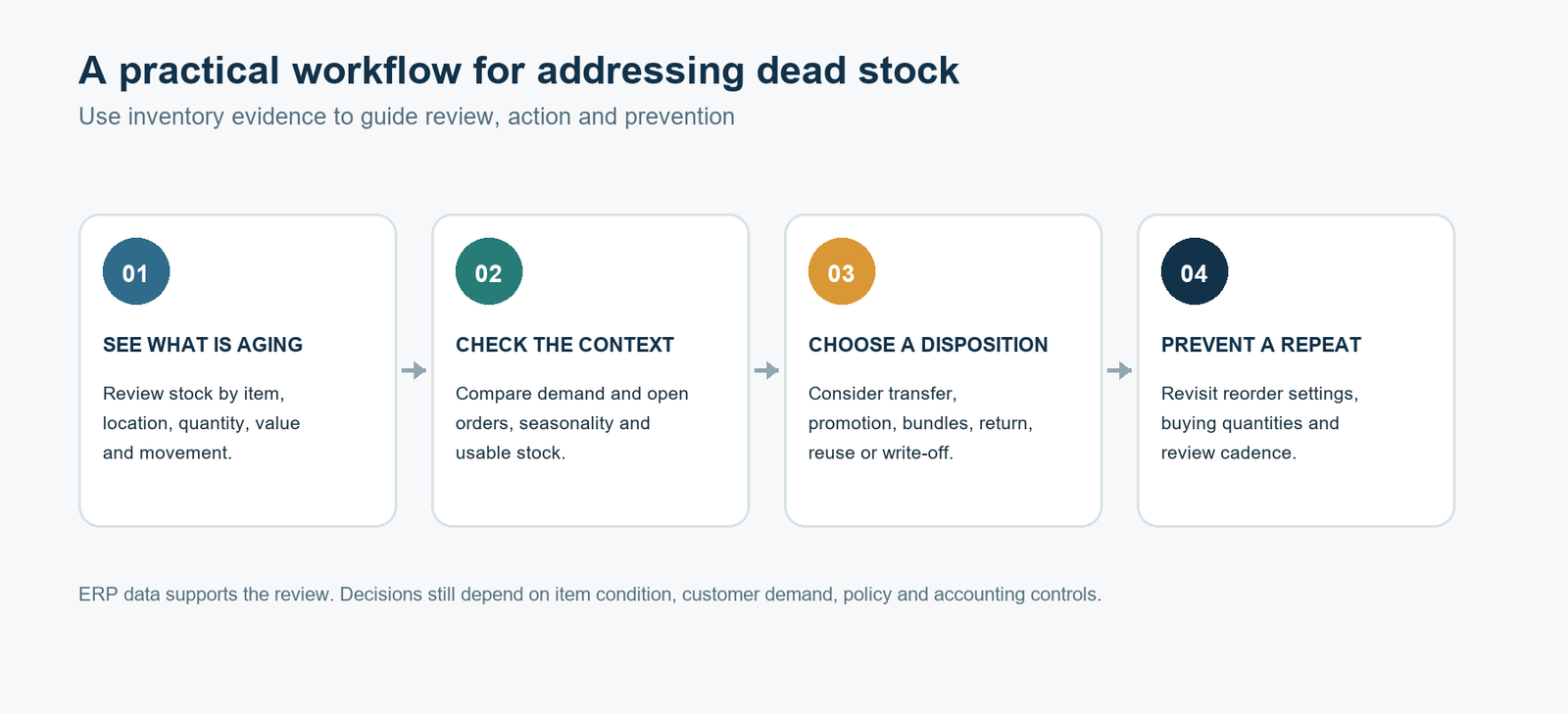
- Run an inventory review. List items with low movement, no recent demand, excess quantities or approaching expiry.
- Prioritise by value and risk. Start with high-value items, and give urgent attention to anything perishable or close to expiry.
- Find the cause. Over-buying, a cancelled order, falling demand, a replaced model or poor coordination? The cause shapes the fix.
- Choose an action. Depending on the product and situation: return eligible goods to the supplier, transfer stock to a branch with demand, run approved discounts or clearance offers, bundle it with faster-moving products, reuse suitable materials in production, or dispose of unusable goods with an approved write-off.
- Stop it coming back. Review purchasing rules, minimum and maximum levels, reorder points and ageing thresholds, and make someone responsible for reviewing exceptions every month.
- Measure progress. Track dead-stock value, ageing stock as a share of total inventory, inventory turnover, and the value actually cleared, not just the value identified.
How True Tech Solutions can help
Our TrueERP inventory solution brings stock, purchasing, sales and accounting into one system, so dead stock shows up early instead of at year-end. Every business stocks and sells differently, so we start by understanding how stock moves in yours, then show you how to spot slow-moving and dead stock, buy against real demand and make better use of what you already hold.
Not sure where your inventory stands? Book a free inventory health check with our team.
Let’s talk about your inventory
Dead stock usually builds up gradually, and it can be cleared the same way: with accurate records, regular reviews and a clear process for acting on what you find. Tell us how your stock and purchasing work today, and let’s find the approach that frees up the most cash for your business. Consultations are free.
- Call +92 51 6109291
- Email info@truetech-sol.com
- Visit Office No. 255, 2nd Floor, Lexus Mall, Gulberg Green Block-B, Islamabad (Mon–Fri, 9 AM – 6 PM)
- Online Send us a message
- Chat Use the chat button on this page to ask a quick question